Finding Calm, Clarity, and Meaning in Everyday Life
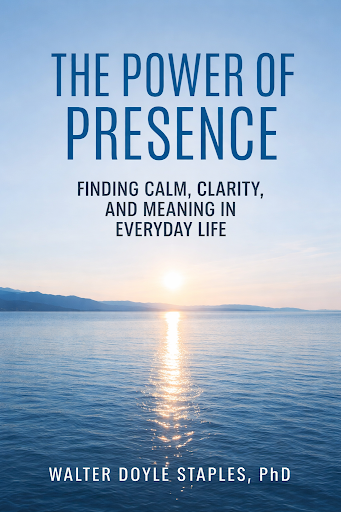
THE BOOK, THE POWER OF PRESENCE

The following is for academic readers and others who are familiar with this topic, namely, the power of Presence in daily life and how best to teach young adults ways to deal with mental health issues that may arise. The book is a reflective and practical work that explores one of the most fundamental yet under-examined dimensions of human psychological life: The quality of attention with which we meet our experience. Drawing on integrative psychology, contemplative traditions, neuroscience and evolutionary insights, the book argues that many contemporary forms of psychological distress – anxiety, fragmentation, compulsive striving, and loss of meaning – are not merely clinical or situational problems but symptoms of a deeper attentional and existential imbalance. At its core, the book advances a simple but far-reaching premise: Our well-being depends not only on what we think and feel, but on how present we are to our own experience. Presence, in this work, is not framed as a mystical or esoteric concept or as a productivity technique, but as a trainable mode of awareness that restores coherence between cognition, emotion, body, and the environment.
Presence as a Psychological Capacity
Rather than treating Presence as synonymous with mindfulness alone, The Power of Presence presents it as a multi-dimensional psychological capacity involving attentional stability, sensory immediacy, emotional openness, and reflective depth. Presence is described as the condition in which perception precedes interpretation, and experience is allowed to register fully before being categorized, judged, or instrumentalized. From this perspective, the author suggests that much of modern psychological suffering arises from chronic absence – a state characterized by mental over-activity, anticipatory anxiety, rumination, and disembodiment. In such states, individuals live predominantly in imagined futures or rehearsed narratives of the past, rarely being in the immediacy – Now – of lived experience. The book proposes that this attentional fragmentation undermines emotional regulation, weakens meaning-making, and erodes an important sense of connection to self and others. It should be no surprise that being “thunk” is a no-brainer. It’s also a “no-gainer” as we stay locked in place: same-old thinking; same-old results.
Interdisciplinary Foundations
The book is intentionally interdisciplinary as it draws from psychological science, particularly research on attention, emotion regulation, stress, and cognitive overload; neuroscience, especially discoveries related to default mode activity, attentional networks, and neuroplasticity; contemplative traditions including Buddhist, Stoic, and phenomenological approaches to awareness; and evolutionary perspectives that suggest the human nervous system evolved for direct engagement with immediate environments rather than constant abstraction, stimulation, and symbolic overload. By weaving these perspectives together, the book avoids positioning itself as either purely scientific or purely spiritual. Instead, it occupies a middle ground increasingly recognized in contemporary scholarship that acknowledges the limits of reductionism while remaining grounded in human biology and evolutionary psychology.
Presence and Modern Life
A central theme of the book is the mismatch between evolved human capacities and modern world conditions. The author argues that while humans evolved in environments that demanded sensory attunement, embodied awareness and situational responsiveness, contemporary life privileges speed, abstraction, and continuous stimulation. Digital technologies, social media, and performance-driven cultures intensify this mismatch by rewarding divided attention and perpetual comparison. The book does not advocate withdrawal from modern life, nor does it reject technology or ambition. Rather, it asks a more subtle question: What happens to the human psyche when attention is continuously fragmented? The author suggests that without the deliberate practice of Presence, individuals become increasingly reactive, anxious, and disconnected – not because they are weak or disordered, but because their attentional systems are overwhelmed.
Calm as a Tool For Nervous System Regulation
One of the book’s key contributions is its reframing of calm. Calm is not presented as passive relaxation or emotional suppression, but as a regulated nervous system capable of responsiveness rather than reactivity. Drawing implicitly on polyvagal and stress-response research, the book suggests that Presence allows the body to shift out of chronic threat states and into conditions where curiosity, learning, and social engagement are possible. Through everyday examples rather than clinical case studies, the author illustrates how moments of Presence – pausing, sensing, breathing, and noticing – can interrupt habitual stress loops. Calm, in this framework, becomes a by-product of attentional alignment rather than a goal pursued by itself through force of will.
Clarity and Meaning
The book further argues that clarity emerges naturally when attention stabilizes. When individuals are less consumed by internal noise, they are better able to perceive what matters, discern values, and make decisions aligned with their deeper priorities. Clarity here is not certainty, but coherence – the sense that one’s thoughts, emotions, and actions are not pulling in opposing directions. Meaning, in turn, is described not as something to be discovered intellectually but as something that arises experientially through Presence. The author challenges the modern tendency to treat meaning as an abstract philosophical problem, suggesting instead that meaning is felt when individuals are fully engaged with their lives, relationships, and inner experience. It is Presence that restores meaning, not by providing answers but by deepening contact with the “is-ness” of life.
The Power of Presence is not a technical academic text, nor does it present novel empirical findings. Its contribution lies in translation, integration, and articulation. It seeks to make complex psychological and contemplative ideas accessible without diluting their depth, and to invite readers – both general and scholarly – to reconsider the role of attention in mental health and human flourishing. For academic readers, the book may be of interest as (1) a conceptual synthesis that complements empirical research; (2) a culturally sensitive articulation of contemplative ideas for secular audiences; (3) a bridge between evolutionary, psychological, and phenomenological perspectives; and (4) a reflection on how modern environments shape – and strain – human cognition and individual well-being. Ultimately, the book argues that Presence is not a luxury or lifestyle choice but a psychological necessity. In an era marked by distraction, acceleration and uncertainty, the ability to be present may be one of the most important human skills to cultivate, not only for individual well-being and growth, but also for collective resilience, advancement, and flourishing.
Honor the present moment. Indeed embrace it with all your heart.
This will move your mind from doubt and dismay to hope and happiness.
It’s an awakening of immense proportions, an experience you
can have no other way.


Comments