Mindfulness Teachings Across History
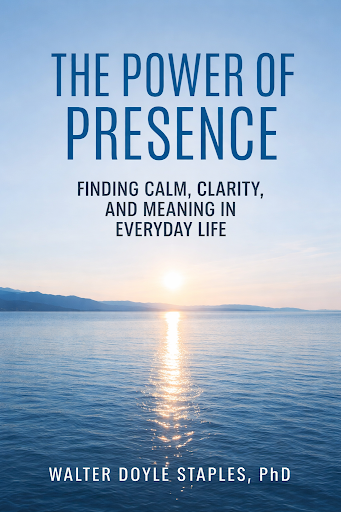
THE BOOK, THE POWER OF PRESENCE

There is a quiet river flowing beneath every civilization
Long before mindfulness became a modern word, before it was measured in brain scans or repackaged as stress reduction, human beings were already discovering – again and again – that the deepest freedom available to us does not come from controlling the world, but from discovering our true selves. Roughly between 800 and 200 BCE – what philosopher Karl Jaspers called the Axial Age – a most remarkable convergence occurred across cultures. Without direct contact with each other, sages in China, India, Greece, and the Middle East began articulating the same radical insight: Human suffering is intensified by needless unconsciousness but alleviated by acute inner awareness. Consider the following:
The Buddha diagnosed suffering (dukkha) as arising not from life itself but from craving, aversion, and ignorance. His solution was neither belief nor obedience but practice: Mindful attention to breath, body, sensation, and thought. Liberation (nirvana) was not elsewhere, it was here, when the mind ceased gasping and grasping. Lao Tzu, writing the Tao Te Ching, described a way of living aligned with the Tao – the natural flow of reality – through wu wei or effortless action. The sage does not force the world but rests in it. “Be still,” he implies, “and the muddy water will clear.” Marcus Aurelius, emperor of Rome, practiced Stoic reflection not as philosophy but as mental hygiene. In his book, Meditations are exercises in Presence: returning attention to what is in one’s control and releasing what is not. The Upanishads and later yogic traditions in India taught liberation comes through realizing the Self (Atman) beneath thought and identity, a direct ancestor of modern witnessing awareness. Christian contemplatives – from the Desert Fathers to Meister Eckhart – spoke of hesychia – inner stillness, and the “ground of being” where the soul rests in God beyond words. Across traditions, the language differs but the experience does not. Presence was not invented, it was remembered.
The Industrial Revolution, followed by the digital age, did not erase this wisdom, it simply buried it beneath the noise. Speed, productivity, and consumption gradually displaced stillness, sufficiency, and inwardness. The mind became a tool for achievement rather than a necessary space for awareness. Yet the river resurfaced.
Two developments are of note in the 20th and 21st centuries. First, neuroscience confirmed what contemplatives knew all along: Attention reshapes the brain, and calm awareness reduces reactivity. And trauma research revealed that healing requires not analysis alone but embodied Presence: Learning to feel safe again. What changed was not the truth but the urgency. Humanity now possesses technologies capable of global annihilation while lacking the maturity to wield them wisely. This is the context in which The Power of Presence arrives – not as nostalgia, but as necessity.
This book is a work of integration and not escape. It does not offer transcendence as an escape from life; it offers immanence as a return to life. This distinction is very important. Many self-help works promise relief by changing circumstances, improving outcomes, or by optimizing performance. This work points elsewhere: to the quality of being from which all action arises. In doing so, it joins the lineage of contemplative classics while speaking in a contemporary, accessible voice.
One of the central strengths of The Power of Presence is its insistence that Presence is experiential, not theoretical. You do not argue or force people into peace; you invite them to sit, breathe, and simply notice. Deep breathing is presented not merely as a relaxation technique but as a doorway into the parasympathetic nervous system – a physiological act of surrender. Visualization is framed not as wishful thinking but as intentional action, shaping emotional tone and meaning. Affirmations, when grounded in awareness rather than denial, become anchors that steady the mind instead of slogans that bypass it. These things matter because suffering is not solved by ideas alone. Anxiety, anger, and trauma live in the body as much as in thought. An emphasis on daily practice honors this truth. Presence helps brings an end to inner violence, to psychological distress as a form of inner conflict. The mind attacks itself with rumination, judgment, and fear. Memory becomes a weapon, and imagination becomes a threat generator. Presence interrupts this violence – not by suppressing thought, but by disarming identification. When a person learns to witness anger rather than be possessed by it, something revolutionary occurs: Anger loses its moral authority; hurt becomes sensation rather than story; and fear is felt without being obeyed. This is not indifference, it is intimacy without fusion. Over time, the nervous system learns a new baseline. Reactivity softens. Compassion becomes possible not as virtue, but as by-product. In this sense, The Power of Presence is not about people becoming better, it is about people becoming less divided.
A predictable question arises along the path from inner peace to outer harmony: Is this all too personal, too simplistic? The fact is, there is no outer peace without inner calm because the outer world is built by inner states being multiplied. Anger, hate, and violence do not arise in a vacuum. They are the externalization of inner conditions. Fear seeks control, insecurity seeks dominance, and unexamined pain seeks an enemy. History’s worst atrocities were not committed by monsters who knew they were monsters, but by human beings who were unaware, too closely identified with ideology, grievance, or righteousness. Presence undermines these forces at their root. It reveals thoughts as thoughts, not truths; it exposes narratives before they harden into identities; and it creates a pause – often just a breath – between impulse and action. This simple pause is where ethics are born.
Families can stop the inheritance of trauma. In the home, Presence changes everything: Parents who regulate their own emotions model safety; children who feel seen and heard learn self-trust; and conflict becomes dialogue and not domination. Trauma is not transmitted through events but through nervous systems. Presence shuts down this transmission. It does not guarantee perfect parenting, but it does reduce unconscious harm. Over generations, this is transformative.
We should start teaching Presence in our schools and universities. An effort to integrate Presence into education is not idealistic, it is pragmatic. Students today are saturated with information but are starving for attention. Teaching mindfulness improves emotional regulation, it enhances learning and creativity, and it reduces bullying and polarization. More importantly, it teaches a meta-skill: How to be with oneself. A society that educates attention rather than only intellect produces citizens who are capable of mindful discernment rather than mindless reaction.
We need to consider our places of work, from burnout to meaning. In institutions that are driven by metrics, Presence rehumanizes labor: Leaders who act from awareness rather than fear create trust; employees who are present experience dignity, not just productivity; and decisions improve when they are not hijacked by ego or urgency. This is not spiritual escapism, it is organizational intelligence.
Some churches and religious institutions themselves are returning to the sacred. Ironically, many religious institutions lost Presence by emphasizing belief and ceremony over the experience and understanding of daily life. Presence quietly restores the contemplative heart common to all traditions. Presence does not compete with faith, rather it deepens it. Silence becomes prayer. Awareness becomes reverence. Dogma yields to humility and common sense.
We need to also consider Presence and the role it can play regarding world peace. To boldly assert that Presence is essential to ending large-scale conflict may strike some as naïve and impractical. It is not. It is a radical as well as a realistic claim. We know weapons are easy while wisdom is hard. Bombs and bullets are tools of mass destruction because they are extensions of unexamined minds. Technology amplifies intention, it does not purify it. When fear, greed, and tribalism go unchecked, destruction scales faster than rationality and compassion. Diplomacy alone cannot solve this because treaties are written by minds that are still prone to reactivity. Policy needs Presence. Conflict begins with dehumanization. Presence restores humanity by making it impossible to see others as abstractions. A person who is grounded in awareness feels their own fear, and therefore recognizes it in others; they notice the mind’s tendency to divide, and resist it; and they act firmly when necessary, but without malice. The difference lies in inner posture. Action taken from Presence is measured, not compulsive, and responsive, not reactive.
Cultural change does not require unanimity but critical mass. Practices once confined to monasteries are now entering mainstream life. As more individuals stabilize their inner world, the social field shifts subtly but persistently. Presence spreads not by force but by coherence. Calm is contagious. Listening disarms. Stillness invites trust. This is how civilizations change – not overnight, but from the inside out. At its deepest level, The Power of Presence is not asking readers to add another habit. It is asking them to reconsider who they are: Not the stream of thoughts, not the sum of wounds, and not the roles, labels, or achievements but the acute awareness in which all of them appear. From this recognition flows a new ethic: less certainty, more curiosity; less domination, more dialogue; and less fear-driven action, more intentional response.
This isn’t utopia. Pain will still arise. Loss will still come. But suffering born of resistance, hatred, and unconsciousness can be radically reduced. In a time when humanity itself is at risk – not only from weapons, but from separation of the mind and heart – the book offers something quietly revolutionary: A reminder that peace is not negotiated first in a conference room, but cultivated first in consciousness. If the practice of Presence was taught as naturally as reading, practiced as routinely as exercise and valued as highly as productivity, the world would not become perfect but it would become inhabitable. And that may be the most realistic hope we can have.
We are being asked to consider a new way of being. This is a moment of reckoning. We are living at a decisive time in human history. Never before have we possessed such technological power, such instantaneous communication, such capacity to shape the future of life on Earth. And never before have we been so inwardly unsettled, anxious, divided, reactive, and disconnected from ourselves and one another. The evidence? It is chronic stress and anxiety; increasing levels of loneliness; political polarization; cultural fragmentation; environmental degradation; and the ever-present threat of violence on a massive scale. The root cause? It is our state of mind: unexamined, reactive, fearful, and unconscious. Our survival now depends not only on what we do, but on how we think and not-think. More not-thinking results in better thinking. This is the promise of Presence.
All real growth involves the attraction and internalization
of divine energy and the manifestation of its power and relevance.
The objective is always service—the giving of gifts
for the common good.
The present moment is you without your story, without
your baggage, without your past. You are naked, stripped of your
worldly attire. As such, you are in your original state. Best you
reconnect with it to better understand your true nature.
Thank you.


Comments