See You in the Winner’s Circle
THE BOOK, THE POWER OF PRESENCE
We think. We sense. We experience. And we do all three at the same time. Because of this simultaneity, we assume we are fully engaged with reality. We assume our thinking accurately interprets our senses, that our experience reflects objective truth, and that the conclusions we draw about ourselves and the world around us are sound. Yet this assumption may well be the most consequential misunderstanding in human history.
The hard truth? The combined activity of active thinking, sensing, and experiencing accounts for about 3% of all meaningful human progress. The other 97% lies in a domain most people rarely access and surely do not understand. It’s what is called “transcendental functioning,” an advanced human capacity that emerges not from more thinking but from the practice of less thinking or no-thinking at all while in the state of Presence.
Almost none of us have been trained to use it. And because we have not, we live far below our potential – individually, organizationally, and collectively as a species. If we are to survive and flourish in the 21st century, we must rediscover this forgotten capacity. We must learn to enter the winner’s circle not merely by striving harder, but by transcending the mental noise that keeps us trapped in mediocrity and failure.
The Illusion of Mental Mastery
Modern culture worships cognition. We reward quick answers, clever arguments, rapid analysis, and relentless productivity. From early schooling to professional life, we are taught that the mind – busy, analytical, and constantly processing – is the supreme instrument of achievement. Yet consider this: The mind that is constantly thinking is also constantly reacting. It replays the past. It anticipates every threat. It compares, judges, defends, strategizes, and fears. It is extraordinarily useful for technical tasks. But it is profoundly limited when it comes to deep insight, creativity, courage, and authentic leadership.
The active “thinking” mind is a tool but it is not the master tool. In athletics, we see this often. The tennis player who overthinks their serve and tightens up. The golfer who analyzes their mechanics in mid-swing and loses fluidity. The hockey player who hesitates in order to calculate and calibrate instead of responding instinctively and botches the play. Peak performers consistently describe a different state involving calm, clarity, stillness, and “flow.” They are not thinking less effectively, rather they are functioning from a deeper level of intelligence. In fact, they are in the winner’s circle long before any trophy is ever awarded.
The Three Percent and the Ninety-Seven Percent
When I speak of 3% and 97%, I am not suggesting a literal neurological statistic. I am using a metaphor – and an accurate one – for how human potential is distributed. The 3% is active, deliberate thought. It is planning, strategizing, analyzing, worrying, regretting, hoping, and rehearsing. The other 97% is the field from which all non-thought arises. It is the silent, spacious awareness beneath all the noise and “non”-sense of the mind. It is the deep well of intuition that produces sudden insight. It is the source of creative breakthroughs that arrive when we stop trying to force them.
This is not mystical speculation. It is observable in lived experience. The scientist wrestling with a problem finds the solution singing in the shower. The writer struggling with a paragraph discovers the right phrasing during a quiet walk. The athlete discovers their rhythm when they stop trying too hard. When we are not obsessively thinking, “something” larger appears and begins to operate. That something is “unconditioned” consciousness or precious Presence.
What Presence Actually Is
Presence is not passivity. It is not lethargy. It is not zoning out or escaping reality. Presence is heightened awareness without mental commentary. It is the state in which perception is clear because it is not distorted by anxiety, ego, or habitual narrative. It is the condition in which intelligence operates with maximum efficiency because internal interference has been reduced. Presence is not something we invent, rather it is what remains after we subtract distraction and distortion.
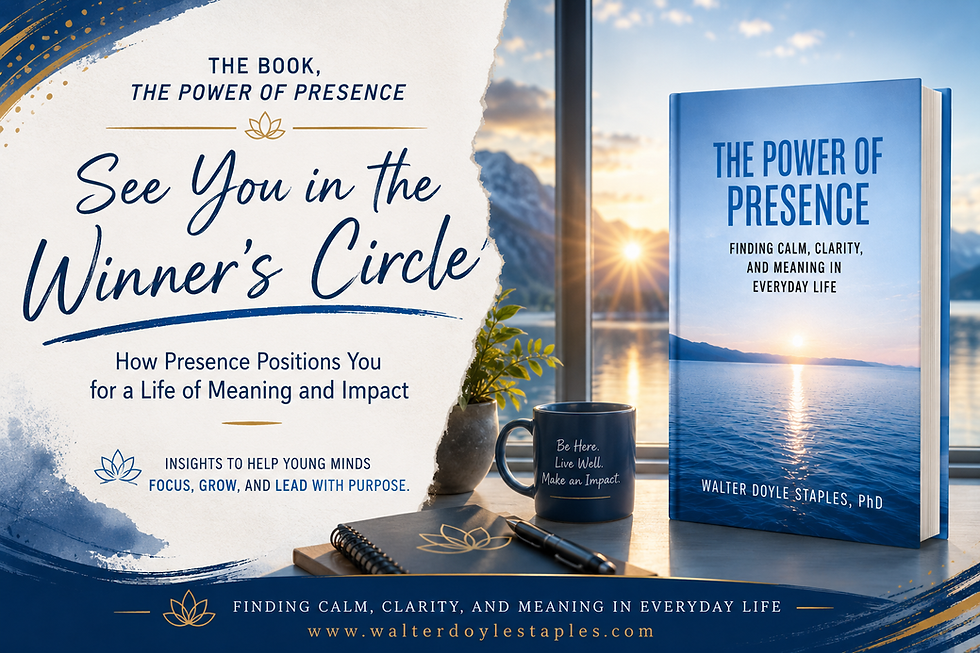
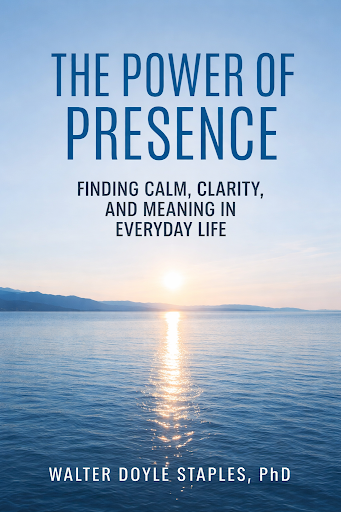
In my book The Power of Presence, I describe this as returning to our natural operating system. Human beings are wired for clarity. But like a computer running too many background programs, we slow ourselves down with constant internal chatter. When we deliberately spend time each day in stillness – without screens, without noise, without analysis – we reset the system. This is transcendental functioning. It is not about thinking better thoughts. It is about accessing the level of intelligence that exists prior to any thought.
The Winner’s Circle Reimagined
Traditionally, the winner’s circle is a physical place. It’s where a champion stands after a competition. It represents achievement, recognition, and validation. But that in fact is an outer circle. The winner’s circle is a state of inner consciousness, a certain mindset. It is entered when we stop being driven by confusion, and begin acting from clarity. It is entered when we respond rather than react. It is entered when we recognize that performance excellence arises from internal coherence, not frantic effort. Real winners are not those who are trying to win a trophy. They are those who master their internal environment. They understand that external victory is the by-product of internal alignment. When athletes, entrepreneurs, educators and leaders operate from Presence, their decisions sharpen. Their creativity expands. Their emotional reactivity decreases. They become more adaptive in complexity and more resilient in adversity. In today’s chaotic world, these are not luxuries. They are notable and indispensable survival skills.
Why Our Species Is at Risk
We live in an age of unprecedented stimulation. Critical commentary, shouting, alerts, and headlines all compete for our attention. The human nervous system was not designed for continuous cognitive overload. The result is collective agitation. An agitated mind cannot perceive clearly. It exaggerates threats. It misinterprets signals. It divides reality into simplistic categories of “us” and “them.” It becomes tribal, defensive, and impulsive. When entire populations operate from unexamined reactivity, the consequences are predictable: polarization, conflict, environmental neglect, and short-term thinking. Our dilemma is not technological. It is psychological, sometimes philosophical. We believe we are thinking our way forward, but in fact we are amplifying the very noise that prevents wisdom. The 97% – our capacity for deep, non-reactive awareness – remains largely unused. And because it remains unused, we make decisions from fear rather than from clarity. The stakes are high.
Transcendental Thinking: The Paradox of Not-Thinking
The phrase “transcendental thinking” sounds contradictory. How can thinking involve not-thinking? The answer lies in understanding that insight seldom originates from frantic and unconscious effort. Insight arises more often when the mind becomes quiet, and seldom-seen patterns or hidden truths reveal themselves. When the surface of a lake is agitated, it reflects nothing clearly. When it becomes still, the reflection sharpens. Transcendental functioning involves that same stillness. It is cultivated through deliberate, daily practice – 10, 20, or 30 minutes spent in Presence. In the present moment. Not problem-solving. Not journaling. Not strategizing. But simply sitting. Breathing. Observing. Contemplating. Over time, something remarkable begins to happen: reactivity diminishes; emotional triggers loosen; and the gap between stimulus and response widens. Within that gap lies freedom. And within that freedom lies mastery, first of the mind followed by the self and all that the self experiences and reacts to.
From Presence to Performance
Skeptics often ask if stillness actually translates into measurable results. The answer, emphatically, is yes. Athletes who practice calm visualization improve execution under pressure. Leaders who cultivate reflective silence make more strategic long-term decisions. Students who develop focused attention learn more efficiently. Presence enhances performance because it reduces internal friction. Consider the serve in tennis. Physical coordination matters. Expert coaching matters. Strength training matters. But if the server is tense, mentally replaying past double faults and is anticipating failure, the mechanics necessarily crumble. When the player steps to the line grounded in calm awareness and is anticipating success, however, their body performs what it has already practiced a thousand times. Presence allows excellence to express itself. This principle extends to every field of endeavor. The equation? Simply enough, it’s preparation plus Presence equals peak performance. P+P = PP.
The Discipline of Daily Practice
The winner’s circle is not entered accidentally. Presence must be practiced with the same seriousness as coaching and conditioning. A few minutes of casual relaxation here and there are not sufficient. The nervous system requires regular exposure to deep stillness in order to rewire habitual stress patterns. This is not about escape. It is about practice and repetition. Just as muscles strengthen through resistance, awareness strengthens through intentional quiet. At first, the mind resists: It tries to escape into a series of hopes and fears, successes and failure. This is normal. The practice is not to suppress such thinking but to observe it without attachment. Then, gradually, the volume lowers. The 97% becomes accessible. And daily life begins to change. Reactions soften. Listening improves. Creativity emerges spontaneously. Decisions feel less forced and more aligned. The outer world may remain complex, but the inner world becomes calmer, clearer, and steadier.
Leadership in the Age of Complexity
Life rewards those who remain calm amid volatility. Information overload will only get worse. Artificial intelligence (AI) will expand and create both new opportunities and moral dilemmas. Social pressures will undoubtedly intensify. But those who cultivate Presence will navigate such complexity with patience rather than panic. Presence-based leadership listens deeply. It is not prone to impulsive action. It seeks systemic understanding instead of surface blame. Organizations that prioritize this development will out-perform those that rely solely on strategy and speed. The winner’s circles of the future will not be occupied by those with the loudest voice or quickest action, but by those who have mastered simplicity and stillness.
A Call to Conscious Evolution
Human beings have evolved physically and technologically at astonishing rates, yet our psychological evolution has not kept pace. We have developed extraordinary tools but insufficient self-mastery. The practice of Presence is not merely self-help, it is personal growth. It is conscious evolution. It represents the next step in our development, namely moving from compulsive thought to in-the-moment, intentional awareness. If enough individuals commit to daily transcendental practice, collective consciousness shifts. Decision-making improves. Dialogue deepens. Conflicts de-escalate. Now the 97% becomes a shared resource rather than an untapped reserve. This is not utopian idealism. It is practical necessity.
See You in the Winner’s Circle
When I say, “See you in the winner’s circle,” I am not promising a gold medal. I am inviting you into mastery – of mind, body, and spirit. The circle is entered each morning when you choose stillness over stimulation. It is entered each afternoon when you pause before reacting. It is entered each evening when you reflect rather than ruminate. External victories soon follow. But the deeper victory is internal sovereignty – the ability to remain centered in a crazy, chaotic world. Simply enough, effort without Presence produces strain, and effort aligned with acute awareness produces excellence.
The future of performance – athletic, professional, economic, educational, and civilizational – depends on our willingness to cultivate this inner resource. We think we understand ourselves because we are actively thinking all the time. But true understanding begins when our thinking slows down to zero. The advice? Spend time each day in Presence. Access the 97% of your mind that you have overlooked but is eagerly waiting to hear from you. Lead from a position of strength, namely from stillness, silence, and solitude. Compete from calm. Create from clarity. Continue with confidence. And I will see you – calm, clear, and consciously evolved – in the winner’s circle!
The student asks,
“Master, who are we
when we stop thinking?”
The Master replies,
“Oh, that’s easy. Just stop
thinking for fifteen minutes
and find out for
yourself.”
The student asks,
“Master, how can I find my
true self … enlightenment?”
The Master replies,
“Oh, that’s easy. Simply lose
your false self, then notice
what is left.”
The student asks,
“Master, what is the joy
of awakening?”
The Master replies,
“Oh, that’s easy. Simply go
into the place of no-mind and be,
and find out for yourself.”
Thank you.


Comments