The Cultivation of more Rational, more Advanced, and more Enlightened Thinking
THE BOOK, THE POWER OF PRESENCE

Introduction
As a species, we are undoubtedly rational, empathetic beings capable of problem-solving. We can sort through alternative solutions and live cooperatively with each other, both with the greater good in mind. Throughout history, this has been the norm rather than the exception. Yet today we are failing on a grand scale. Are our various forms of government – including autocracies, dictatorships, monarchies, and democracies – at fault? Our institutions? Is human “nature” involving our inherited DNA – and the insidious ego that comes with it – to blame? Or “nurture,” our upbringing until about age 12? We have proven to be technologically creative. We have found ever more efficient ways to kill each other since our species first appeared on the planet about two million years ago. Now this capacity is even more advanced with the advent of artificial intelligence. Scary times are upon us. Not only is our species at risk from war and its devastation, so is the planet as global warming has progressed to a dangerous level.
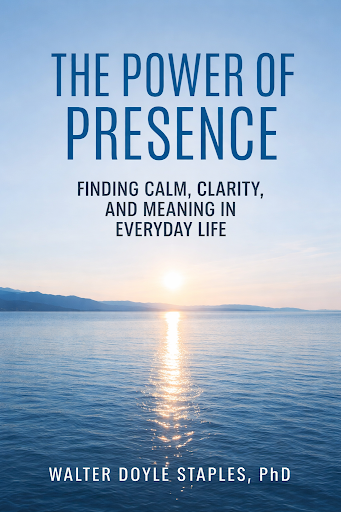
Let’s consider for a moment the merits of my new book, The Power of Presence: Finding Calm, Clarity, and Meaning in Everyday Life. What remedies or approaches other than Presence and clarity of thought are available to us to stop the carnage? The destruction? The pain? The suffering? And if Presence – which is a way of advanced, critical thinking – is indeed our best hope, what can people who see the possibility of a breakthrough do to get the message out to the general population as well as people of influence and power?
An excellent question. It goes to the heart of what many peace thinkers have struggled with for centuries. If we look honestly at human history, technological progress has often outpaced rational, more advanced thinking. From clubs and spears to nuclear weapons, cyber-warfare and autonomous weapons systems, our capacity to kill each other has grown exponentially. The question is not only how to stop weapons development, but how to transform the thinking minds of those who may use them.
Remedies
Besides Presence, many approaches have been proposed. Diplomacy and international institutions such as the United Nations have helped prevent conflicts from escalating. Yet diplomacy often addresses disputes after fear, anger, and mistrust have already taken firm root. Economic interdependence. The theory is that nations that trade together are less likely to fight one another. While often true, economic ties alone do not eliminate nationalism, ideology, or historical grievances. Education. Better education can foster critical thinking and empathy. However, highly educated societies have also declared war on others. Democracy and human rights institutions can reduce violence within societies, but democracies themselves are not immune to conflict. Conflict resolution, peace-building, mediation, reconciliation, and dialogue have all achieved remarkable success in places like Northern Ireland and South Africa. Yet these required leaders and citizens who were able to calmly listen and eager to learn.
Why Presence may be different
What makes the concept of Presence distinctive is that it operates at a deeper level. Presence is not merely a diplomatic, social, economic, educational, organizational, or political strategy. It is a state of consciousness, an advanced and more effective and meaningful way of thinking. A leader who is fully “present” is less likely to be overtaken by fear, anger, rage, ideology, pettiness, propaganda, or historical resentment. A person who is present is less susceptible to manipulation and hatred. Presence itself does not eliminate disagreement, but it changes the quality of thought that underlies the decision-making concerning its resolution. In this sense, Presence may be the foundation that allows other tools to work more effectively. It could be argued that many wars begin not because people lack intelligence or rationality, but because they lack calm, clarity, and deep concern.
How to get the message out
If peace is one of the core messages in The Power of Presence, the challenge is how to move the idea beyond the book itself. Ideas: Publish articles in peace and security journals. Introduce the concept to university peace studies programs. Offer guest lectures to military colleges and diplomatic training institutes. Create a concise, “Declaration of Peace Manifesto” of about 1,000 words. Launch a website devoted specifically to Presence, peace, and global security. Record short videos explaining the idea in practical terms. Appear on podcasts focused on leadership, psychology, international affairs, and conflict resolution. Build relationships with scholars, diplomats, military leaders, and peace advocates who can become ambassadors for the concept. Most importantly, frame Presence not only as a spiritual or philosophical idea, but as a practical leadership competency. Policymakers, diplomats, and negotiators are often receptive to ideas that improve judgment, understanding, situational awareness, and decision quality.
A central thesis
The most powerful statement regarding this book may be something like: Humanity's greatest threat is not the various sophisticated weapons themselves that it develops, but the quality of thinking that applies to the way people will manage and control them. How can hate, anger, and blind ambition be reduced or better managed? How can practicality and rationality be top of mind before one party attacks and tries to destroy another? If the central thesis previously stated is true, then Presence is not simply one more peace initiative among many. It becomes a prerequisite for every lasting peace initiative that follows. This is a message that could resonate not only with peace activists, but also with military leaders, diplomats, educators and politicians, indeed anyone who is concerned with the future of our civilization.
There is a major distinction that needs to be made between the means of peace and the conditions of mind and state-craft that make peace possible. Most peace efforts throughout history have focused on the means: treaties; diplomacy; economic cooperation; international law; deterrence; peacekeeping; education; conflict resolution; and democratic institutions. All of these matter. They lower risk. They reduce suffering. They save lives. But they operate largely at the level of “systems.” Presence focuses on something that is much deeper: The quality of consciousness itself, and the thought processes that create these systems in the first place. This is an important distinction. Human beings are not failing because we lack basic intelligence. After all, we are responsible for super computers, space exploration, modern medicine, philosophical arguments, advanced transportation systems, and global communications.
The problem is not a shortage of intelligence. Nor is it a shortage of information or creativity. Never in history have people had access to more information or been more creative in so many fields of endeavor. Yet conflicts persist and wars are being waged. One could argue the fundamental challenge is not intellectual capacity but the manner and depth of how human beings think, ponder, wonder, debate, and decide. Fear distorts perception. Anger narrows options. Hate fuels revenge. Ideology can become a substitute for rationality. Ego demands victory rather than understanding. These forces affect everyone: diplomats; generals; presidents; CEOs; and activists of all kind.
This is where the concept of Presence becomes even more interesting. If Presence is defined as heightened awareness, emotional regulation, clarity, rationality and the capacity to observe reality without being overwhelmed by fear or ego, then it addresses the very conditions under which decisions are made. In this sense, Presence is less a “peace” strategy and more a “decision-quality” strategy. And history is a testament to many catastrophes that arise from poor decisions at moments of extreme consequence.
Many wars begin because leaders misread intentions, pride prevents compromise, fear produces over-reaction, assumptions replace facts, and emotional escalation outpaces rational analysis. Presence, when consistently and diligently practiced, seeks to reduce noted failures like these.
Unfortunately, the world of influence and power rarely adopts ideas because they are morally attractive or conceptually appealing. It adopts them if they are seen as useful. That observation may shape how The Power of Presence is positioned. Rather than presenting Presence primarily as a calming philosophy, it should be presented as a practical framework for effective leadership, higher-quality judgment, improved strategic thinking, enhanced situational awareness, reduced emotional reactivity, and more effective conflict resolution.
Military leaders understand situational awareness. Diplomats understand misinterpretation and misunderstanding. Business leaders understand decision quality, return on investment, and risk. Educators understand cognitive development. Psychologists understand emotional intelligence and mind management. Presence as a concept can potentially speak to all of them. The question then becomes how to reach the people who really matter. Clearly, it is less about selling a book and more about proposing an idea.
Ideas spread quickly when they move through respected institutions. Consider military colleges: The Royal Military College of Canada. United States Military Academy. Senior command and staff colleges around the world. Diplomatic training programs: United Nations Institute for Training and Research. Foreign-service academies. International mediation programs. Universities: Peace studies. Leadership studies. Public policy. Risk management. Evolutionary psychology. Think Tanks: Brookings Institution. Council on Foreign Relations. International Crisis Group. Leadership Development Organizations: Government leadership programs. Executive education. Corporate leadership institutes.
The most receptive audience is probably not peace activists as a group. It may be people responsible for making consequential decisions under pressure and high risk. Here is another consideration. The peace movement has traditionally focused on stopping war. The Power of Presence may have an opportunity to focus on something much broader and more effective: The cultivation of more calm, rational, advanced, and enlightened thinking. War then becomes a symptom of a much larger problem, namely that human beings frequently make important decisions while operating from a position of fragility and vulnerability: fear; worry; regret; anger; resentment; tribalism; and emotional reactivity. If Presence reduces those influences, then its application extends far beyond international conflict. It affects families. Communities. Organizations. Politics. Economies. Education. Business. And certainly close relations between nations themselves.
Can Presence alone actually eliminate war?
Ideally, yes. But practically, here are some well-known limiting factors:
(1) Ego – our self-centeredness and self-righteousness – is part of our inherited DNA. It is not going away any time soon. Fear, hate, anger, glory, and greed will always be part of the human mindset.
(2) Acrimony and disagreements between countries will continue to arise. Both of these observations are valid. However, even if Presence cannot guarantee peace, it can increase the probability that individuals and institutions will choose wiser, more considerate, and less destructive courses of action. This is a claim that is both ambitious but also defensible. And if we want to influence people in positions of power, it may be the most persuasive way to frame the message. The world does not need leaders who are merely more informed. It already has a surplus of these. It needs leaders who are acutely aware, clear-minded, emotionally balanced, pragmatic, reality-based, and capable of seeing viable alternatives to potential conflict whether the stakes are high or low. It has almost none of these.
If The Power of Presence can convincingly argue that Presence helps cultivate these capacities, then it is contributing not only to the discussion of peace, but to one of the oldest questions in human history itself: How can we humans become wise enough to manage the incredible power that we possess? Good question!
Thank you.


Comments